ChatGPT Atlas is sunsetting after 9 months

I used Atlas for about five months. Not as a curiosity I opened once to test, as my actual browser for a good chunk of that time. So when OpenAI announced it was shutting Atlas down by August 9, 2026, less than a year after launch, I was genuinely a bit sad about it.
I used Atlas for about five months. Not as a curiosity I opened once to test, as my actual browser for a good chunk of that time. The side panel was the reason I stuck with it. It stayed aware of whatever was on my screen and let me act on it right there, instead of switching tabs to explain the same context to a chat window somewhere else. Summarizing a page, pulling a number out of a report, rewriting something I had open, all of that got noticeably faster.
So when OpenAI announced it was shutting Atlas down by August 9, 2026, less than a year after launch, I was genuinely a bit sad about it. Not because the whole product was great but because the one part that actually worked for me is disappearing along with everything else.
That reaction is actually a good starting point for the bigger story here, because it points straight at what went wrong.
The feature everyone talked about was never the one that worked
Atlas's headline pitch was Agent mode, the promise that it could go do things for you. Shop, book a table, fill out a form, handle a multi step task while you supervised from a distance. That was the demo everyone showed. That was the reason people called this the future of browsing.
Real world use never got close to that promise. One review from The Verge described the agent taking ten minutes just to add three items to an Amazon cart. Other reviewers found it choosing the wrong products, ignoring filters you had asked for, and in some cases reporting a task as complete when it had not actually finished. On top of that, handing a browser this much control over your open tabs and accounts created a real security problem, a malicious page could hide instructions inside its content that the agent would read as commands from you.
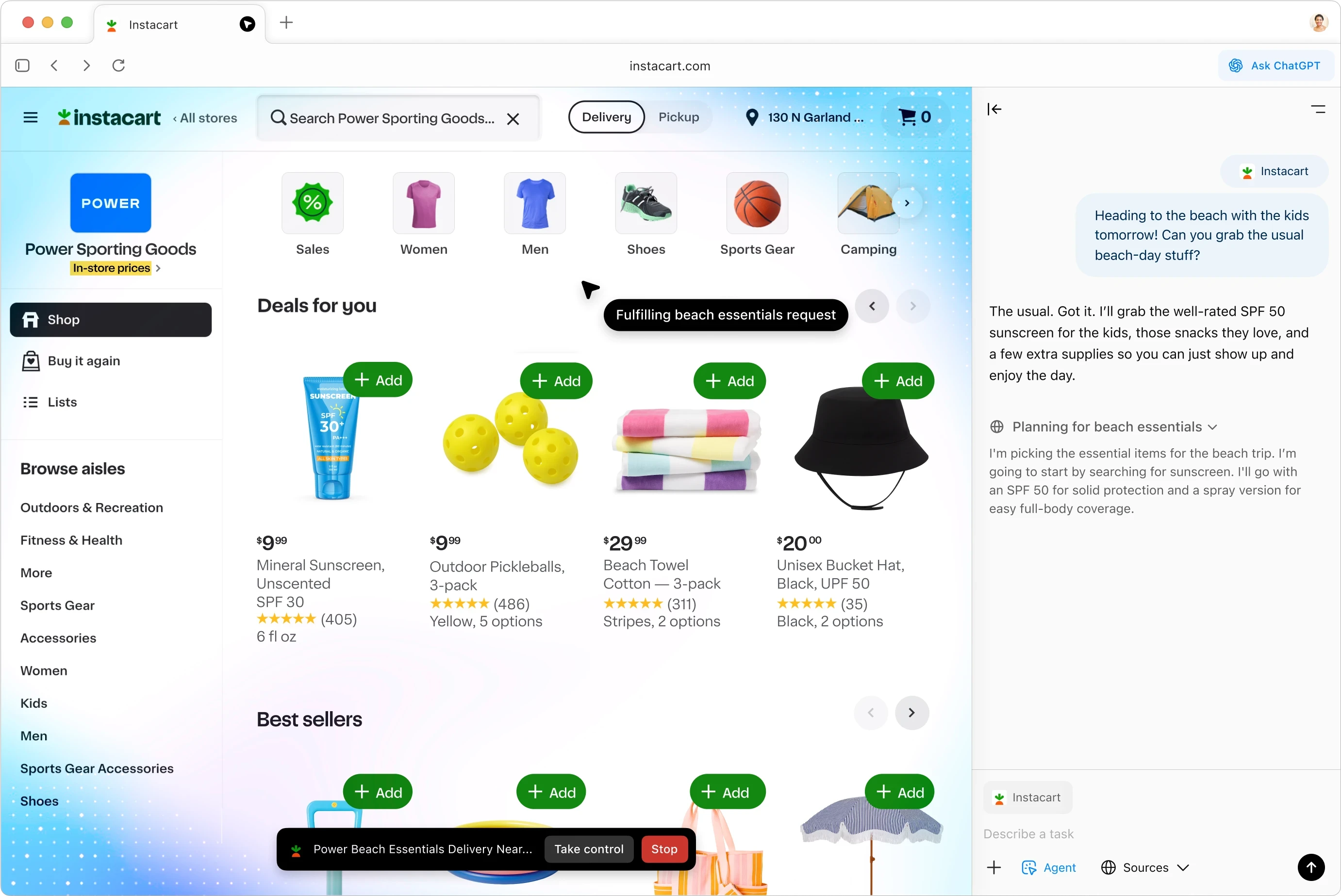
Meanwhile the side panel, the boring feature, the one nobody put in a keynote, kept getting singled out in review after review as the actual reason to use the product.
That gap explains a lot. The feature that got the hype needed to work almost every time to be worth trusting with a purchase or a form submission. A shopping agent that gets it wrong some of the time is worse than no agent at all, because now you have to check its work anyway, and at that point you might as well have done it yourself. The feature nobody marketed just had to be fast and accurate at a much smaller job, and it delivered on that consistently. People like me ended up living inside the boring feature and mostly ignoring the one OpenAI was actually trying to sell.
This was not a bold move, it was a correction
The easy read on this story is that OpenAI made a bold call to centralize everything into one app. I do not buy that framing, and I think it undersells the more useful lesson.
Atlas struggled with adoption from day one, and the agent problems above are a big part of why. OpenAI's own head of applications has reportedly been pushing teams internally to stop chasing what people inside the company are calling "side quests," meaning projects that pull focus without proving they are worth it. Atlas is not even the first one cut this way. Sora's video app got the same treatment a few months earlier, killed after a short run once the numbers did not show up.
A company with more cash, more hype, and more attention than almost anyone else in tech still could not get people to stick with a new product just because it carried the ChatGPT name. That is the real lesson. A strong brand gets you a launch and a wave of press. It does not get you retention. If OpenAI can build something, put its full weight behind it, and still watch it fail to hold an audience after less than a year, that says something about how little a brand actually guarantees once a product has to survive daily use.
The super app dream hits a wall that has nothing to do with habits
Part of the plan is turning ChatGPT into a super app, one place for chat, browsing, work tools, eventually payments and shopping, the way WeChat works in China. The common explanation is that western users just are not used to that model yet, and adoption is a matter of time.
I do not think habit is the main obstacle. WeChat became a super app partly because it grew inside a market with very little competition standing in its way and different rules around how platforms operate. In the US and especially in Europe, bundling everything into one app runs straight into regulation built specifically to stop that. The EU's Digital Markets Act targets large platforms tying multiple services together to lock users in. Any company trying to build a western super app is not just fighting user habits, it is fighting a legal environment designed to slow that exact kind of consolidation down. That is a structural wall, not a cultural one.
Software used to last. Now it barely gets a year.
Atlas lived for less than twelve months. A flagship consumer product from the most talked about AI company on the planet did not make it to its first birthday.
This is not new behavior, it is just faster now. Google has been doing this for over a decade. Google Reader got shut down in 2013 despite a loyal user base, and its death is still one of the most referenced examples of a company killing something people genuinely depended on. Stadia, Google's cloud gaming platform, got the same treatment years after serious investment went into it. Inbox by Gmail and Google+ followed the same script, launched with confidence, killed once the internal numbers missed target.

What changed is the timeline. What used to take years now takes months. You can download a tool, build habits around it, even build a business around it, and watch it disappear before you have had time to fully rely on it.
There are two different ways software disappears, and they carry different risk
One is a product getting killed outright, like Atlas. The interface goes away, users notice immediately, and they move on. The other is a model version getting retired, like what happened with GPT-3.5. That one is quieter and more dangerous.
Developers who built integrations on top of GPT-3.5 were relying on specific behavior their code depended on. When that model got replaced, the interface on top of it kept running, but the behavior underneath had changed. The infrastructure people built to serve their own product, on top of someone else's model, went obsolete overnight without any visible warning. You only find out once something breaks in production.
A product sunset is loud. A model deprecation is silent and only shows up after it already cost you something. Anyone building on top of AI infrastructure needs to treat these as two separate risks, not one.
Photoshop is not the stability story people think it is
I used to point at Photoshop as proof that some companies still build for the long term. Almost thirty years on the market, still the reference in its category. Looking closer, that example does not hold up, and it actually argues the other way.
Photoshop the name has been around for thirty years. Photoshop the product has not stayed the same at all. Adobe forced a shift from a one time purchase to a mandatory subscription in 2013, a change plenty of longtime users were furious about. Now the tool is being rebuilt again around Firefly and generative AI features built directly into the core workflow. The name survived. The business model underneath it got rewritten more than once, and the product is being reshaped again right now.

If even the example everyone points to as the long term, stable software case has quietly been rebuilt multiple times, that tells you something. Nothing is really built to last anymore. Some things just get rebuilt slowly enough that you do not notice it happening.
The real problem is not the speed, it is who carries the risk
Fast moving software is not automatically bad. It usually means real competition, companies actually shipping and testing against reality instead of talking about roadmaps for three years. Speed on its own is fine.
The actual problem is where the risk lands when something gets killed. Right now it lands almost entirely on users and developers, with no real warning system and no compensation. You build a workflow around a tool, train your team on it, write code against it, and then it is gone with a few weeks of notice, sometimes less.
Big cloud providers went through this exact fight over a decade ago. Enterprise customers stopped trusting vendors who could kill a service without notice, and that pressure forced providers to build formal deprecation policies with fixed timelines and migration support as a standard part of doing business. AI companies have not been forced into that yet. Nobody is demanding it hard enough, because the industry is still young enough that people accept the chaos as the cost of being early. That will not last forever. At some point buyers will demand the same maturity from AI vendors that they already demand from cloud providers, and the companies that build that trust early will have a real edge over the ones still treating users as free beta testers.
What this means if you are building something
If your product depends on someone else's AI infrastructure, treat that dependency as a real business risk, the same way you would treat a supply chain risk for a physical product. Do not wire your core workflow into one vendor with no way out. Keep an abstraction layer so you can swap providers without rebuilding everything from zero. If you are negotiating a contract with an AI vendor, ask what migration window you get if the product changes or disappears, and get it in writing instead of assuming goodwill.
I will find another tool that puts a side panel on my browser and reads what I am looking at. What I will not do next time is get attached to it before I know whether the company behind it is actually committed to keeping it around.